




Why Are Some Chili Peppers Hotter Than Others?
A jalapeño can produce a considerable burning sensation, but it is nowhere near the intensity of a Bhut Jolokia, Trinidad Scorpion or Carolina Reaper. Even two fruits of the same variety can have different heat levels.
The explanation lies mainly in capsaicinoids, a group of natural substances produced by plants of the Capsicum genus. The best-known is capsaicin, which is responsible for much of the burning sensation we experience when eating a hot chili pepper.
What Is Capsaicin?
Capsaicin is a compound that activates certain heat-sensitive receptors in our bodies. The brain interprets this signal in a way similar to high temperatures, even though the chili pepper is not actually burning tissue in the same way as a source of heat would.
That is why we feel a burning sensation in our mouths and may experience sweating, watery eyes or a feeling of warmth after eating a very hot chili pepper.
Where Is the Heat Concentrated Inside a Chili Pepper?
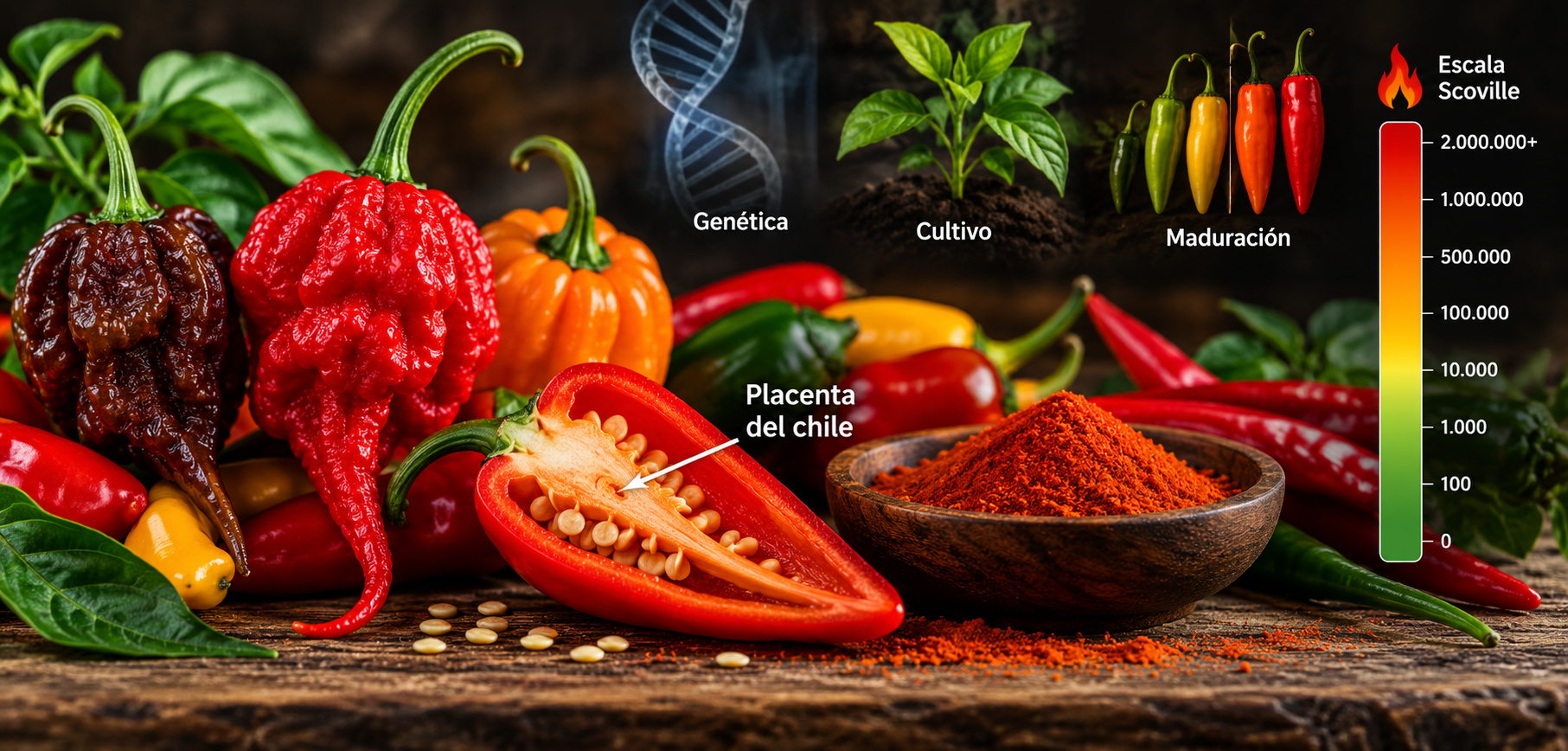
There is a widespread belief that the seeds are the hottest part of a chili pepper. In reality, capsaicinoids are produced mainly in the internal tissues associated with the placenta of the fruit, the pale structure to which the seeds are attached.
The seeds can come into contact with these tissues and become coated with capsaicinoids, but they are not the main area where these compounds are produced.
1. Genetics Is the Most Important Factor
The main reason why some chili pepper varieties are much hotter than others lies in their genes.
A sweet pepper produces virtually no capsaicinoids, while superhot varieties such as Carolina Reaper, Trinidad Scorpion and certain 7 Pot peppers have an enormous genetic capacity to produce them.
That is why we cannot turn a sweet pepper into a Carolina Reaper simply by changing its watering, temperature or fertilizer. Growing conditions can have an influence, but the plant's potential is primarily determined by its variety.
2. Growing Conditions Can Also Have an Influence
Once the genetic potential has been established, the environment in which the plant grows can affect fruit development and composition.
Factors such as temperature, water availability, nutrition, light and plant stress may be associated with variations in capsaicinoid concentrations.
This helps explain why two plants of the same variety do not necessarily produce fruits with exactly the same characteristics.
3. Watering and Water Stress
It is sometimes claimed that allowing a chili pepper plant to become extremely dry will automatically make its fruits much hotter. The reality is more complicated.
A certain degree of water stress can alter the plant's response, but excessive stress can damage growth, reduce yields, cause flower drop and affect fruit quality.
Therefore, deliberately stressing a plant to try to increase its heat is not recommended. A healthy, properly cultivated plant has a better chance of expressing the potential of its variety.
4. Temperature and Light
Chili pepper plants generally benefit from warm temperatures and plenty of light. Temperature affects numerous metabolic processes in the plant and can contribute to differences in fruit development.
However, excessively high temperatures can also cause pollination problems, flower drop and stress.
5. Fruit Ripening
Chili peppers undergo numerous changes as they ripen. The pigments responsible for their color, aromas, sugars and other fruit components all change.
Capsaicinoid concentrations can also vary during this process. This means that harvesting time may influence the final perception of heat.
However, the exact changes depend on the variety and the conditions under which the plant has developed.
How Is Chili Pepper Heat Measured?
Heat is usually expressed in Scoville Heat Units (SHU).
The scale is named after Wilbur Scoville, who developed a method for evaluating pungency through dilution and tasting in the early 20th century.
Today, much more precise instrumental methods can be used to analyze the capsaicinoids present in a sample.
| Chili Pepper Type | Approximate Heat Level |
|---|---|
| Sweet pepper | 0 SHU |
| Jalapeño | 2,500–8,000 SHU |
| Habanero | approx. 100,000–350,000 SHU |
| Bhut Jolokia | around 1,000,000 SHU |
| Carolina Reaper | over 2,000,000 SHU at the upper end |
Why Can Two Chili Peppers from the Same Plant Have Different Heat Levels?
A variety's Scoville rating does not mean that all its fruits have exactly that value. There is natural variation.
The position of the fruit on the plant, its development, ripening stage and environmental conditions experienced during growth can all contribute to differences between fruits.
That is why published SHU ratings for a variety are often expressed as ranges or values obtained from particular samples.
Are Smaller Chili Peppers Hotter?
Not necessarily. The size of a chili pepper alone does not determine its heat level.
Some small chili peppers are extremely hot, while others are relatively mild. Similarly, some superhot varieties produce fairly large fruits. Knowing the variety is much more important when estimating its heat potential.
Does Color Indicate How Hot a Chili Pepper Is?
No. Red, yellow, orange, chocolate, white and purple colors are mainly characteristics related to the genetics and pigments of the fruit.
Extremely hot varieties can be found in many different colors. A red chili pepper is not automatically hotter than a yellow or chocolate-colored one.
Genetics + Growing Conditions + Ripening
Ultimately, there is no single factor that explains every difference in chili pepper heat.
Genetics establishes the main potential of each variety. Environmental conditions, plant health and fruit development can then produce variations within that potential.
This combination is one of the reasons why growing chili peppers is so interesting: even when cultivating the same variety, each season may bring small differences.
Varieties such as Bhut Jolokia, Trinidad Scorpion, 7 Pot and Carolina Reaper can reach extremely high heat levels. Handle fruits and seeds carefully, avoid touching your eyes and wash your hands and utensils thoroughly after working with them.
Heat Is Part of the Extraordinary Diversity of Chili Peppers
From a sweet pepper with 0 SHU to superhot varieties that far exceed one million Scoville Heat Units, the Capsicum genus displays extraordinary diversity.
And it is precisely this combination of shapes, colors, aromas, flavors and heat levels that has made growing chili peppers a passion for growers and collectors around the world.